Sunday, December 28, 2014

#42 - Atrocity


Germany's Atrocity have been all over the metal map over their nearly thirty years of existence, starting out as a death metal band before moving into a more gothic sound in the early 90's, followed by a foray into industrial metal in the late 90's, a hiatus in the early 2000's and finally a return to death metal (this time tinged with gothic and black metal) with their latest release, 2013's Okkult.  It seems to me their winding and unconventional career arc has been largely influenced by vocalist/founder's relationship with and marriage to Norwegian soprano vocalist Liv Kristine, with whom all Atrocity members have a symphonic/gothic metal band called Leaves' Eyes since 2003, as evidenced by the increased use of soprano vocals and introduction of gothic and black metal elements into the band's sound (Liv was at one time involved in popular and influential black metal band Cradle of Filth).  Two things though that have remained consistent over the multiple years of style and personnel changes have been creative and detail-oriented musical composition and precise technical execution of it, and Atrocity excels at all of various styles they've tackled.


I enjoy all of Atrocity's work, and there are so many different looks at them I could offer you here.  I'm going to go with my favorite industrial song of theirs, which is not characteristic of much of what I listen to, but they do it so well, particular the angular phrasing, dynamic contrast and sound layering.  I do however have to call out their 1997 release, Werk 80, which compiles an odd assortment of covers of 80's pop tunes as something particularly worth listening to.  Tanz Der Teufel, below, comes from their subsequent release, 2000's Gemini.  Check it out for a catchy and subtly creative piece of fun.


Sunday, November 23, 2014

#43 - Twisted Into Form


At number 43 comes our fifth Norwegian band, the incredibly adventurous Twisted Into Form.  I don't think this was ever anything more than a one-off, but wow what a one-off it is.  According to the band, they started working on writing the album around the year 2000 and six years later produced an album that clearly required every minute of the interim to prepare.


"Instinct Solitaire", the song I've chosen to share with you, comes charging right out of the gate; up-tempo and twisty as all get out.  The introduction foreshadows some of the song's thematic material, but is mostly all over the place rhythmically and melodically, setting the listener up for the kind of relentless technical playing and shifting time that's in store.  The vocals enter at 0:31 over an only slightly more consistent feel.  The chorus at 0:57 is a bit more melodic still, but don't expect "Rainbow Connection".  There's a brief guitar at 1:26, which leads into an instrumental section which builds quickly from a quiet jazzy arpeggiated lead at 1:37 to a recap of the head at 2:05 followed by a coda from 3:03 to the end.  Prepare to have your mind blown.


Thursday, November 20, 2014

#44 - Dio


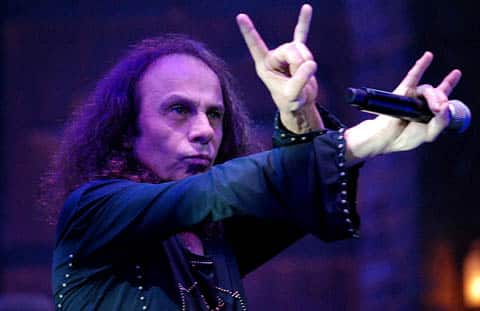
One of the most influential vocalists in the history of metal, Ronnie James Dio set out on his own in 1982 after three successful albums with Rainbow and two more with Black Sabbath to lead his own band, Dio.  Known for their theatrical, high fantasy lyrical content, stage sets, costuming and album art, as well as the grandiose stage presence and vocal performance of their diminutive leader, Dio released 10 studio albums and numerous live albums over about 20 years.  Sadly, Ronnie died of stomach cancer in 2010.  His legacy can be heard in countless bands, both his vocal influence and his writing which championed the weak and the suffering, promising hope of redemption, and he's been covered by a host of top notch metal bands: Metallica, Anthrax, Yngwie Malmsteen, Motörhead, Fates Warning, Tenacious D, Scorpions, Blind Guardian, Stryper, Doro, Jag Panzer, Stratovarius, Killswitch Engage, Gamma Ray, Dan Swanö, Adrenaline Mob, Halestorm, Corey Taylor of Slipknot and Rob Halford of Judas Priest to name a few.


Dio (both the band and the man) had a number of terrific albums, but the solo debut Holy Diver stands apart as a classic and is widely regarded as one of the best metal albums of all time.  Featuring a rhythm section from his past (drummer Vinny Appice of Black Sabbath and bassist Jimmy Bain from Rainbow) and up-and-coming Irish guitar shredder Vivian Campbell, the playing is as strong as the writing from beginning to end.  While "Rainbow in the Dark" was the album's biggest hit, I was always partial to the head-bob-inducing title track, included below.  Enjoy, especially Ronnie's captivating vocal performance.


Sunday, November 2, 2014

#45 - Derek Sherinian


Fellow Burbank resident, Derek Sherinian joins Jens Johansson as one of two great solo metal keyboardists on my top 100.  "Metal keyboardists?" you ask.  "Is that a real thing?"  Listen below, friend, and you will hear that it is very real indeed.  I first encountered Derek's playing as the keyboardist for Dream Theater, which he was for one and a half studio albums in the mid-nineties, the half being one of my two favorite of their releases.  Prior to his stint in Dream Theater, he had attended Berklee College of Music and served as keyboardist for Alice Cooper.  After Dream Theater, he essentially became a solo and session artist, performing with a veritable who's who of brilliant musicians over the last 15-20 years.


Derek's first solo effort became a multi album collaboration called Planet X, and featured virtuosi Tony MacAlpine on guitar and Virgil Donati on drums.  Their music strikes me as jazz metal fusion... like Chick Corea meets Metallica.  They're a terrific listen in their own right and highly recommended.  His next six albums feature an amazing array of guitarists: Steve Lukather, Zakk Wylde, Ynwie Malmsteen, Al Di Meola, Allan Holdsworth, Steve Stevens, John Sykes, John Petrucci, Brad Gillis, Slash, Rusty Cooley, Tony MacAlpine, Doug Aldrich and Joe Bonamassa.  They also boast a rhythm section mainly consisting of Tony Franklin on bass and Simon Phillips on drums.


Derek's entire body of work (at least the third or so of it with which I'm familiar) is impressive and well worth multiple listens.  He favors distorted sounds, aggressive technique, a lot of pitch bending and generally phrases a lot like a shredding guitarist but on keys.  I'm including "Axis of Evil" from the 2003 release Black Utopia because I find the concept (and execution) of dueling guitars done by Zakk Wylde and Yngwie Malmsteen completely irresistible.  Derek pitches in with some soloing too, and you can get a bit of a taste of his unique and enjoyable style.


Saturday, October 25, 2014

#46 - Soundgarden


Soundgarden enters the countdown as the second band from Washington, just five spots above fellow state residents Queensrÿche.  They are generally considered among the grunge movement's founding fathers, and while there may be some truth to that, I think it's at least as much to do with their relationship with other Seattle-area bands and entrance to the scene on Sub Pop Records as with their musical style, which in my opinion could just as easily be described as heavy metal - perhaps with progressive and/or doom leanings.  Their debt to 70's metal juggernaut Black Sabbath is certainly discernible and difficult to refute, although their punk origins are as well.  Like other area bands of the time, they eschewed flashy guitar solos in favor of a rawer sound.  But Soundgarden also favored downtuned guitars, odd meters, heavy drums and more vociferous lyrical content and delivery than their compatriots.


To me, 1991's Badmotorfinger came out of nowhere, like a lot of the Seattle output around that time.  I had never heard of Soundgarden, and suddenly they (although less-so than Nirvana and Pearl Jam) were all over the place.  I was working in a record store at the time, and picked it up after hearing the below single, "Outshined".  The bulk of the song is super heavy... it sounds like it's tuned down about a fifth and the bass drum on the kit sounds enormous - powerful and sinister.  It opens with the main riff in 7 and goes straight into the verse over it.  Vocalist Chris Cornell really sounded unlike anyone else, and in a good way.  After two verses, we hear a bridge to the chorus at 1:19, which is over an equally heavy slow 4-feel and ends with a cool hemiola-backed repetition of the song title back into the main 7-beat riff.  The form to this point repeats a second time, after which an unexpected groovy, softer interlude at 3:31 leads back into one more statement of the chorus (with an extra-tasty surprise extension at 4:41) and out.  Hard to believe it's been 23 years since "Outshined" came out.  To me, Badmotorfinger and 1994's Superunknown stand the test of time and remain excellent albums, classics, all these years later.


Sunday, October 12, 2014

#47 - Fates Warning


Our second of the "Big 3" progressive metal bands, which includes Queensrÿche as well, Fates Warning is also our second in a row to emerge from the early 80s burgeoning underground and progressive metal scene.  They started off as almost an Iron Maiden knock-off, with a lot of galloping rhythms, high-pitched vocals with wide vibrato, and tempos and riffs very reminiscent of Number Of The Beast era Maiden on their debut album, Night On Bröcken.  There is a hint of what's in store on the track "Damnation" which shows some progressive tendencies (and this before there really was much of a model, aside from godfathers of prog metal Rush), and it wasn't long before Fates Warning showed their penchant for the more grandiose side of metal.  Their sophomore effort, "The Spectre Within" from 1985 demonstrates sci-fi themes (opener "Traveler in Time") and longer compositions (all but one of the tracks are over 5 minutes including the 12 minute epic "Epitaph").  By their third album, 1986's Awaken The Guardian, the move from NWOBHM-inspired traditional metal band to prog metal pioneers was complete.  Unfortunately, 1987 brought a split between the band and standout vocalist John Arch, but the band really didn't miss a beat recruiting Ray Alder (who later doubled in Redemption) and becoming, if anything, more adventurous and proggy with their classic albums No Exit, Perfect Symmetry, and later A Perfect Shade of Gray.


I'm including a song off of Awaken the Guardian, which is probably my favorite of their many great albums.  I'm partial to the heavier sound of their early years and also to John Arch's vocal pyrotechnics.  "Valley of the Dolls" is the second track on the album and mostly up-tempo, with a lot of time changes, extra beats thrown in at the ends of phrases and formal twists and turns.  It's an impressive composition and performance, all the more so when you consider that it was released in 1986.  In terms of technique, it's not far behind what WatchTower was doing around that time, and it's a whole lot more cohesive.  After a traditional, Maiden-like start, the band quickly gets down to business with an alternating 4-5 feel halfway through the song's introduction at 0:15.  Then at 0:30, the band shifts from a duple to triple feel, maintaining the eighth note tempo... I'm a sucker for shifts like this.  The last bar of the phrase has an extra beat, setting up and delaying the arrival of the vocal entry at 0:42, where you get your first taste of Arch's amazing voice and delivery.  At 1:25, it's back to duple, but this time the big beat stays constant (dotted-quarter becomes the quarter).  There are a few more flip flops between those two feels with a lot of trick beats and shifts thrown in through multiple instrumental, vocal and solo sections, all pretty frenetic, to the sudden ending.


Tuesday, September 30, 2014

#48 - Mercyful Fate


Legendary Danish band Mercyful Fate may not have gotten a ton of mainstream attention during their brief first run, but they've had a huge influence on heavy music of various sub-genres ever since.  Back in 1983, when early heavy bands like Iron Maiden, Mötley Crüe, Def Leppard, Quiet Riot and Twisted Sister were launching a golden age of metallic, big-haired popularity, a healthy but less well-known metal underground was giving birth to game-changing "extreme" metal bands like Celtic Frost, Venom, Metallica and Mercyful Fate.  Fate played a blend of progressive and traditional metal styles, overlaid with horror-flick lyrics about the occult and the other-worldly shrieking of one-of-a-kind vocalist King Diamond.  The thematic material and King's gothic facepaint would later influence hundreds of black and gothic metal bands over decades.  Maybe less obviously, the twin-guitar sound, storytelling lyrics and sly compositional complexities have had nearly equal effect on the progressive metal movement, and can be heard in such disparate acts as the Norwegian band Pagan's Mind (whose 2004 reissue of their debut album Infinity Divine features a cover of King's "At the Graves") and Japan's offbeat ensemble Sigh.


Fate's second (and last for their first go-around) album was 1984's fantastic Don't Break The Oath.  The first song, "A Dangerous Meeting" is a good example of their sound at the height of their powers.  It opens with an introduction that builds a bit to the guitar statement of the main riff alternating between a 6- and 8-beat time signature at 0:29, unaccompanied at first except for the rhythm section punctuations.  There's a brief guitar solo over the riff once the rhythm section joins in full, until King's entrance on the verse at 0:47.  The song's story is of a small group of amateur occultists who are meeting to perform a ritual to summon a spirit.  They're in for a rude surprise.  After a repeat of the intro feel and another verse, there's a brief half-time feel at 1:49 until the guitar solo over a lopsided 4 at 2:03, the end of which betrays their Judas Priest influence with a descending 7-beat scale back into the main riff.  After a restatement of the verse and half-time sections, the song makes a left turn at 3:38, launching into a 6/8 gallop with a hitch in it for the first couple of iterations, and then into an ultra-heavy dirge at 4:10, signifying the demise of the seven naive dabblers and the transport of their souls to hell.  The dirge is followed by a final recapitulation of the main riff (over which King wails one of my favorite lyrics, both ironic and apt: "Some people have lost their way... Some people have lost their mind!") and a brief but effective coda that closes the song like the lid of a coffin.